DDR5 is reshaping modern memory markets, from cloud servers to high-end desktops. This guide examines China’s top 10 DDR5 suppliers and the engineering behind their products. It also explains Why DDR5 is faster than DDR4 in practical, measurable terms. The comparison matters because memory performance affects loading times, multitasking, artificial intelligence workloads, and data-center efficiency.
The JEDEC JESD79-5 standard defines DDR5 starting at 4,800 MT/s, while mainstream DDR4 commonly reaches 3,200 MT/s. That difference can deliver about 50% higher raw data-transfer speed. Micron’s DDR5 technical materials also describe dual independent 32-bit channels, improved command efficiency, and on-die ECC. These changes help DDR5 handle more simultaneous requests. The improvement is not only about clock speed.
Power efficiency matters too. DDR5 generally operates at 1.1 volts, compared with approximately 1.2 volts for DDR4. A small voltage reduction becomes meaningful across thousands of server modules. TrendForce’s DRAM industry research continues to identify DDR5 as a key growth driver for server and PC memory demand. However, the picture is not perfectly simple. Higher bandwidth does not guarantee identical gains in every application. Latency, processor architecture, motherboard design, and memory tuning still influence real results. Sometimes, the difference feels modest.
Reliable supplier selection therefore requires more than comparing advertised frequencies. Buyers should verify JEDEC compliance, capacity consistency, thermal behavior, testing procedures, warranty terms, and long-term supply capability. Supplier credibility also depends on documented manufacturing experience and transparent quality controls. This introduction provides a practical foundation for evaluating China’s leading DDR5 suppliers. It keeps the technical comparison grounded in standards, industry research, and real purchasing concerns.
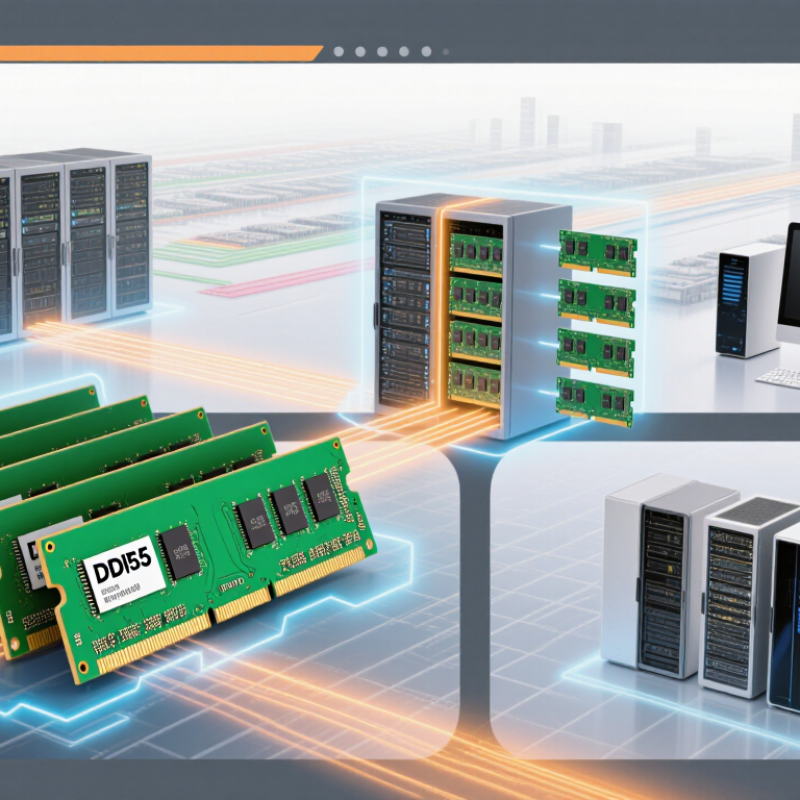
DDR5 is the fifth generation of double data rate memory, designed to move more data per second than DDR4. It serves the same basic role: holding information that a processor needs quickly. The difference is in its architecture and operating characteristics, not in a new kind of storage. Think of it as a wider, better-organized road for data. Not magic.
A DDR5 memory module divides each data channel into two independent 32-bit subchannels. This can help the processor handle separate requests more efficiently. DDR5 also supports higher transfer rates and greater potential module capacities, while its standard operating voltage is lower than DDR4’s. Power management is handled on the module, and on-die error correction helps manage certain memory-cell errors. That feature is not a replacement for system-level ECC memory.
Higher bandwidth can benefit workloads that move large amounts of data, such as some rendering and scientific tasks. But faster rated memory does not guarantee every computer feels faster. Processor support, motherboard compatibility, timings, and the application all matter. In everyday use, the difference may be subtle. A useful comparison checks the full system configuration, not just the DDR generation printed on a module.
DDR5 gains speed through a wider, more efficient data path, not simply a higher clock. JEDEC’s DDR5 standard, JESD79-5, starts at 4,800 megatransfers per second, compared with DDR4’s standard ceiling of 3,200. That is up to 50% more raw transfer rate at those baseline speeds. Real application gains vary. Latency, processor design, and workload still matter.
A DDR5 module splits its 64-bit data path into two independent 32-bit channels. This helps keep data moving when one channel is busy. DDR5 also supports 32 banks, compared with DDR4’s 16, giving memory controllers more opportunities to schedule requests. Small changes add up. The standard lowers operating voltage from DDR4’s 1.2 volts to 1.1 volts, while power management moves onto the module. These choices support higher transfer rates with more controlled power delivery. They do not make every system cooler or more efficient; module capacity and workload affect power use too. The architecture is clever, though setup and tuning can still feel fussy. A fast memory specification is only part of the story.
DDR5 gains speed mainly by moving more data per second, not by making every memory access instantly quicker. Higher data rates let the processor and memory exchange larger streams during demanding workloads.
A DDR5 module provides two independent 32-bit subchannels, compared with DDR4’s single 64-bit channel. That split can improve access efficiency when requests are varied.
Small detail. Longer burst lengths and more bank-level parallelism help keep transfers flowing.
DDR5 also places power-management circuitry on the module, supporting more localized power control. On-die error-correction code can correct certain errors inside memory chips, but it does not replace system-level ECC.
That distinction matters. Higher bandwidth can help with large datasets, such as video timelines or integrated-graphics workloads. Opening a small settings window may show little difference.
DDR5 can have higher latency in some comparisons, despite its greater bandwidth. A higher transfer-rate label alone does not prove a faster computer; the workload, timings, and processor all matter.
China’s top ten DDR5 memory suppliers are best compared by capability, not publicity. Their strengths commonly include memory design, wafer access, module assembly, testing, thermal control, and industrial distribution. Some focus on desktop modules, while others serve servers, edge devices, or automotive systems. DDR5 uses higher transfer rates, two independent 32-bit channels, and improved power management. These features can deliver faster data movement than DDR4, especially in demanding workloads. Real performance still depends on the processor, motherboard, firmware, and workload.
A practical supplier review should examine qualification depth. Strong suppliers provide complete datasheets, stable batch records, compatibility testing, and traceable components. Others compete through flexible customization, smaller minimum orders, rapid sampling, or local technical support. Ten leading suppliers may look similar on paper, but their testing equipment and failure-analysis experience can differ sharply. I have seen specifications appear impressive, yet system stability remained disappointing. That gap deserves attention. Rankings also change as capacity, yields, and product portfolios develop.
Tips: Request samples from several suppliers and test them under sustained load. Check latency, operating temperature, error rates, and firmware compatibility. Ask for production dates and consistency reports. Do not judge a supplier by speed alone. A slightly slower module with reliable validation may serve a real project better. Verify every claim through independent testing and documented quality controls.
Choosing the right DDR5 supplier requires more than comparing advertised speed. JEDEC’s JESD79-5 standard defines DDR5 data rates from 3200 to 6400 MT/s, while common DDR4 modules typically peak near 3200 MT/s. This difference can improve bandwidth for servers, workstations, and data-heavy applications. However, higher numbers do not guarantee better results.
Ask for evidence.
A dependable supplier should provide datasheets, SPD programming details, production-lot traceability, and compatibility testing. Request samples from the same intended batch, then test them under sustained load and different temperatures. TrendForce’s 2024 memory market analysis highlighted continuing volatility in DRAM pricing and supply, so a supplier’s delivery history matters as much as its quotation. Check minimum order quantities, lead times, replacement procedures, and warranty terms in writing. Look for testing records covering voltage stability, error rates, and thermal behavior. DDR5 commonly operates around 1.1 volts, but platform requirements still vary. A module may meet the standard and fail your motherboard. That part is easy to forget. Supplier audits, independent laboratory reports, and clear communication reduce that risk. Price remains important, naturally, but the cheapest offer can become expensive after delays, inconsistent batches, or compatibility failures. I would also challenge vague claims such as “enterprise grade” without measurable evidence. Reliability is built through repeatable process, not impressive wording.
A practical comparison of DDR4 and DDR5 specifications alongside ten checks for evaluating suppliers. The checklist is not a company ranking.
| No. | Evaluation Area | DDR4 and DDR5 Comparison | What to Verify with a Supplier | Why It Matters |
|---|---|---|---|---|
| 1 | Data rate | JEDEC-standard data rates span approximately 1,600–3,200 MT/s for DDR4 and 3,200–6,400 MT/s for DDR5. | Request the exact module data rate, tested configuration, and supporting test documentation. | Higher data rates can increase theoretical bandwidth, but actual performance depends on the full system configuration. |
| 2 | Operating voltage | Standard DDR4 uses a 1.2 V VDD supply; standard DDR5 uses 1.1 V VDD. | Confirm the module follows the required memory generation and voltage specifications for the target platform. | DDR4 and DDR5 modules are electrically different and cannot be interchanged in the same memory slot. |
| 3 | Channel architecture | A standard DDR4 DIMM has one 64-bit data channel; a DDR5 DIMM divides the data path into two independent 32-bit subchannels. | Ask for the module type and technical datasheet, including its channel and organization details. | Two subchannels can improve access efficiency by allowing more independent data operations. |
| 4 | Burst length | DDR4 uses a burst length of 8; DDR5 uses a burst length of 16. | Check that the advertised module specifications match the applicable DDR5 standard and product datasheet. | A longer burst can transfer more data per access, helping support DDR5’s higher bandwidth. |
| 5 | Bank organization | Common standard configurations provide up to 16 banks for DDR4 and 32 banks for DDR5. | Request the memory organization details and ensure they suit the intended CPU and workload. | More banks can allow greater parallelism in memory operations, subject to system and workload limits. |
| 6 | Power management | DDR5 DIMMs generally place a power-management IC on the module; DDR4 module power regulation is generally handled on the motherboard. | Confirm the module’s power-management design, module type, and applicable platform requirements. | The power architecture differs by generation, so motherboard support and module specifications must match. |
| 7 | Error correction | DDR5 memory chips include on-die ECC. This corrects certain errors within the chip but does not replace system-level ECC. | Clarify whether the product is non-ECC, ECC UDIMM, or registered ECC memory, and request the exact part specification. | On-die ECC alone does not provide the same error reporting and correction functions as system-level ECC memory. |
| 8 | Platform compatibility | DDR4 and DDR5 use different electrical designs and physical key positions; a DDR4 DIMM cannot be installed in a DDR5 slot, or vice versa. | Check the motherboard or server platform’s supported memory generation, module type, capacity, and speed. | Compatibility should be confirmed before purchase to avoid unusable inventory and installation delays. |
| 9 | Validation and quality | Memory stability depends on the module, memory controller, motherboard, firmware, and operating conditions. | Request relevant qualification records, sample test results, and evidence of testing with the intended platform or an equivalent configuration. | Testing helps identify compatibility or stability issues that may not appear in a specification sheet alone. |
| 10 | Traceability and supply terms | Lead time, minimum order quantity, warranty, and after-sales terms vary by supplier and product. | Confirm lot traceability, date or batch codes, change-notification procedures, warranty coverage, lead time, and order terms in writing. | Clear documentation supports quality control, production planning, and issue resolution. |
Specification note: DDR4 and DDR5 figures above describe standard memory characteristics; available speeds and supported configurations depend on the module, processor, motherboard, and system settings. Confirm final requirements against current technical documentation for the target platform.
DDR5 moves more data per second, helping processors handle video timelines, large datasets, and integrated graphics workloads.
No. A small settings window may show little difference because latency, software, and processor behavior still matter.
DDR5 uses two independent 32-bit subchannels. DDR4 uses one 64-bit channel.
They help maintain continuous transfers when many memory requests arrive together. This can improve access efficiency.
Yes. Higher transfer rates do not guarantee lower latency or a faster overall computer.
No. On-die correction handles certain chip-level errors. It does not replace full system-level ECC protection.
Review datasheets, batch records, component traceability, compatibility testing, and failure-analysis capability.
Request samples from several suppliers. Test sustained load, temperature, error rates, latency, and firmware compatibility.
Not necessarily. A slightly slower module with stable validation may perform better in a real system.
Impressive specifications without testing evidence deserve caution. I have seen strong claims, yet system stability remained disappointing.
DDR5 represents a major advancement in memory technology, offering higher capacity, improved bandwidth, and better power efficiency than DDR4. Why DDR5 is faster than DDR4 can be explained by its higher data rates, increased internal bank structure, and the use of two independent 32-bit channels within each module. DDR5 also includes on-die error correction and a built-in power management design, helping improve stability and efficiency during demanding workloads such as gaming, content creation, data analysis, and professional computing.
This article introduces the development and architecture of DDR5, explains the technical factors behind its performance gains, and discusses how its design delivers faster data transfer with reduced energy consumption. It also presents ten leading DDR5 memory suppliers in China without focusing on brand promotion, highlighting their manufacturing capabilities, product consistency, customization services, quality control, and supply reliability. Finally, it provides practical guidance for selecting a suitable supplier based on compatibility, capacity, speed, testing standards, delivery capability, and long-term support.

CoreByte